Medieval India · Asymmetric politics · Territorial control

Vijayanagara: The Deccan Empires of Medieval India, 1290–1398

The Deccan Empires of Medieval India, 1290–1398 · GMT base game

Defend the Sultanate. Build a new empire.

Follow Delhi, Bahmani and Vijayanagara through a complete three-player game. Trace tribute, independence, Influence, recruitment and combat as rival ambitions meet Mongol invasions. Original commentary explains the costs and alternatives behind every decision.

Your seat at the table.

3-player playthrough · GMT base game · Guided, at your pace

Open in a new tab ↗
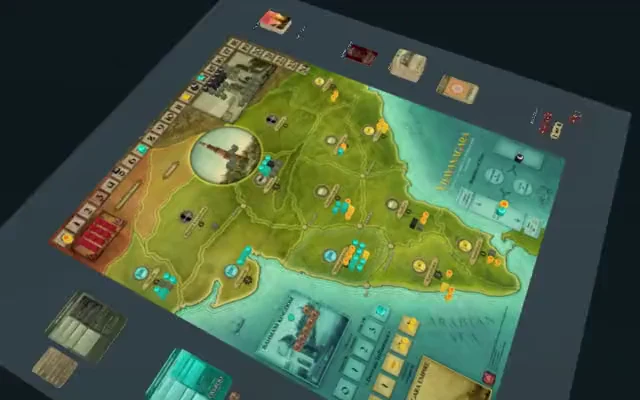
The Vijayanagara tutorial’s 3D game table

See the game unfold.

The complete interactive tutorial, in your browser.

First load: up to approximately 81 MB · Best on a laptop or desktop
Use A− / A+ to enlarge text and controls. Text panel adjusts the reading window.

This detailed game table is best on a larger screen. On a tablet, use landscape mode or open the tutorial in a new tab.

How to use the table

Use A− / A+ to change the size of text and controls. Open Text panel to adjust Width and Height, or choose Reset to restore the defaults. Your preferences are remembered for each game.

Use Next to advance immediately, Previous to revisit a position, and the phase menu, step selection or timeline to jump. Play/Pause controls the visual loop; Skip move finishes the current effect and Skip remaining finishes the current decision. Left-drag to pan, right-drag to orbit and scroll to zoom. Refocus restores the current step; Whole table shows the inventory. Choose a faction perspective, hover highlighted terms or physical components for definitions, click to pin them, and search the glossary or component guide. Enlarge and browse card faces; Escape closes references.

These are guided playthroughs with authored moves and outcomes. Use the checkpoints to explore how the game develops.

If the table does not appear, try opening it in a new tab. A WebGL-capable browser is required.

How to play Vijayanagara: The Deccan Empires of Medieval India, 1290–1398

The objective

Finish with the highest Victory score after the second Timurid invasion. Delhi scores Tributary Prosperity, then adjusts for Mongols surviving in Delhi. Bahmani scores Controlled Prosperity, Forts and Influence; Vijayanagara scores Controlled Prosperity, Temples and Influence. Resources support those plans but are not ordinary victory points.

How a turn works

Reveal the current card and follow its procedure. On Events, Eligible factions act in printed flag order. Two once-per-card forks offer a Command with a Decree, or an Event or Command without a Decree. A Limited Command or Pass can preserve Eligibility for the next Event. Commands and Decrees must each be resolved completely. Invasions and Successions interrupt this flow with their own procedures; they do not behave like an ordinary Event turn.

The ending and this tutorial

This original English base-game route uses three human factions: Mira as Delhi, Owen as Bahmani and Leena as Vijayanagara. Mongol Invaders follow their card procedures with the indicated human controller. All 35 cards, 115 decisions and 465 game effects lead to the actual second Timurid ending. Final Victory is Delhi 5, Bahmani 14 and Vijayanagara 12, so Owen wins. Fixed draws and recorded dice support one teaching route; commentary alternatives do not branch it.

Inside this tutorial

A complete game.
A clearer picture.

Explore the map and prepare all three factions

Tour the Provinces, northern frontier, tracks and supplies, then follow official setup with Mira, Owen and Leena. Each component type and quantity is previewed before placement, with close-ups for small markers and mixed groups.

Connect politics, economy and the battlefield

Follow all 115 decisions and 465 game effects. See Eligibility, Commands and Decrees, tribute recovery, rebellion, Influence, negotiation, attack support and the shared Cavalry supply change the choices at the table.

Resolve the invasions and the actual ending

Continue through all three Successions, six ordinary Invasions and both Timurid cards. Complete the second Timurid invasion and final scoring, then revisit any of the 506 checkpoints to compare the factions’ plans.

Current GMT base rules, March 2024 FAQ and printed faction aids

The current English GMT base rulebook, Learn to Play, Playbook and official March 2024 FAQ were checked on 2 October 2026. The completed route and final source resolutions were reviewed on 4 October 2026, including the printed Mongol aid’s explicit no-Plunder procedure for the second Timurid invasion. This original base-game route uses three humans, fixed draws and recorded dice. Indexed BGG designer discussions and GMT faction guides inform conditional strategy commentary; direct BGG Files and Strategy listings were unavailable. Ibn Battuta opponents, Timur’s Shadow, the optional Goat–Tiger tiebreak and alternative branches are outside this tutorial.

Game details on BoardGameGeek ↗

Another table to explore

Spirit Island

View the tutorial